
Guide
A spring storm-season check for your garage door
NSW storm season has started, and an afternoon spent on five simple garage door checks means you know how your door behaves before wind, rain or a blackout tests it.
The five checks at a glance
Spend one afternoon this month on five checks. Find the manual release. Test the auto-reverse. Look for gaps under and beside the door. Run your eye along the tracks. Clear the area around it.
That's the whole job. None of it needs tools beyond a torch and a broom, and all of it tells you how your door behaves before a storm tests it.
The order matters. The manual release comes first because it's the one you'll need in a hurry. Springs and cables are marked "technician only" for a reason covered further down.
Why spring is the time to do it
NSW SES says September is the beginning of the high-risk weather season, "when the frequency of storms, strong winds and heavy rain typically increases."
The Bureau of Meteorology's outlook for spring 2026, issued on 27 August, describes spring as "a peak time for severe thunderstorms along Australia's east coast". The same outlook gives the east of NSW a high chance of at least 50 to 200 mm of rain across the season.
That's a probability, not a forecast for your street. It is a good reason to fold the garage door into the spring jobs you're already doing on the gutters and the yard.
- 27 August 2026 Bureau of Meteorology long-range outlook for spring issued.
- September 2026 NSW high-risk weather season begins.
- September to November 2026 Spring, a peak time for severe thunderstorms on the east coast. High chance of at least 50 to 200 mm of spring rain in the east of NSW.
- Late September 2026 You are here. Do the checks now.
Source: NSW SES; Bureau of Meteorology.
What storms kept NSW SES busy last season
Last storm season, NSW SES volunteers responded to more than 23,000 incidents, including 18,905 storm-related emergencies. About 7,000 were for fallen trees. More than 6,500 were for leaking or damaged roofs.
Garage doors aren't reported as their own category, so a count for them is unavailable. What the figures do show is where the trouble lands: things falling, and water getting in. Our estimate is that trees and roofs together account for about 13,500 of those emergencies (7,000 plus 6,500).
A garage door is the largest opening in most houses. The same wind and water are working on it.
Source: NSW SES.
1. Find the manual release before the power goes
Storms and blackouts go together. When the power drops, an automatic opener stops, and a door with no other way into the house can leave you locked out or your car locked in.
Most sectional and roller doors with an opener have a manual release: usually a cord with a handle, often red, hanging from the opener's carriage on the ceiling rail. Some also have an outside key release.
Do this with the door fully closed:
- Find the cord and check it hangs where you can reach it.
- Pull it and feel the door disconnect from the opener.
- Lift the door by hand. It should move smoothly and stay put partway up. If it drops or feels very heavy, stop and leave it closed, because that points to a spring problem.
- Reconnect it the way your opener's manual describes, then run the opener once.
The time to learn where the release cord is, is on a dry Saturday, not by torchlight with the rain coming in.
2. Test the auto-reverse and safety sensors
A door that won't stop for an obstruction is a hazard any time of year. After a storm, with branches and debris about, it matters more.
Two quick tests, following your opener manual where it differs:
- Contact reverse: lay a solid object, such as a length of timber, flat in the door's path and close the door. It should reverse or stop when it touches the object.
- Sensor beam: if your door has sensors low on each side of the opening, pass something through the beam while the door is closing. It should stop and go back up.
Wipe the sensor lenses while you're there. A film of dust, cobweb or wind-blown grit can stop them working as they should. If either test fails, stop using the auto-close until it's looked at.
3. Look for daylight under the door and at the sides
Close the door, switch off the garage light on a bright day and look. Daylight under the bottom seal or down the sides is where wind-driven rain will find its way in.
Check the bottom seal for cracks, flattening or sections pulled away. Run your hand down the side and top weatherstrips. Rubber that has gone hard and brittle after a few summers won't seal against a gust.
Near the coast, look closely at metal fixings and the bottom rail for rust. Our guide to why garage doors near the salt wear out sooner shows how that risk changes from Newcastle's surf edge to the western estates.
Before: a cracked, flattened seal, and water tracking inside.
After: a new, even seal sitting flush, and a dry floor.
4. Run your eye along the tracks, rollers and panels
Open and close the door a few times and just listen. Grinding, scraping or a jerky run usually means something is out of line.
Then look along both tracks. You're after dents, bends or brackets that have worked loose from the wall. Check the rollers turn freely and the hinges between panels aren't cracked or missing screws.
Look at the panels themselves too. A panel with loose fixings or a damaged edge is exactly the kind of thing strong wind finds.
5. Clear and secure the area around the door
In strong wind, loose items become projectiles. Bins, pot plants, outdoor furniture and kids' bikes parked against a garage door can end up going through it.
Move what you can inside or well away from the door. Check any overhanging branches you'd be worried about after the season NSW SES has just described. Sweep the driveway apron so water can run off rather than pooling against the bottom seal.
What to leave to a technician
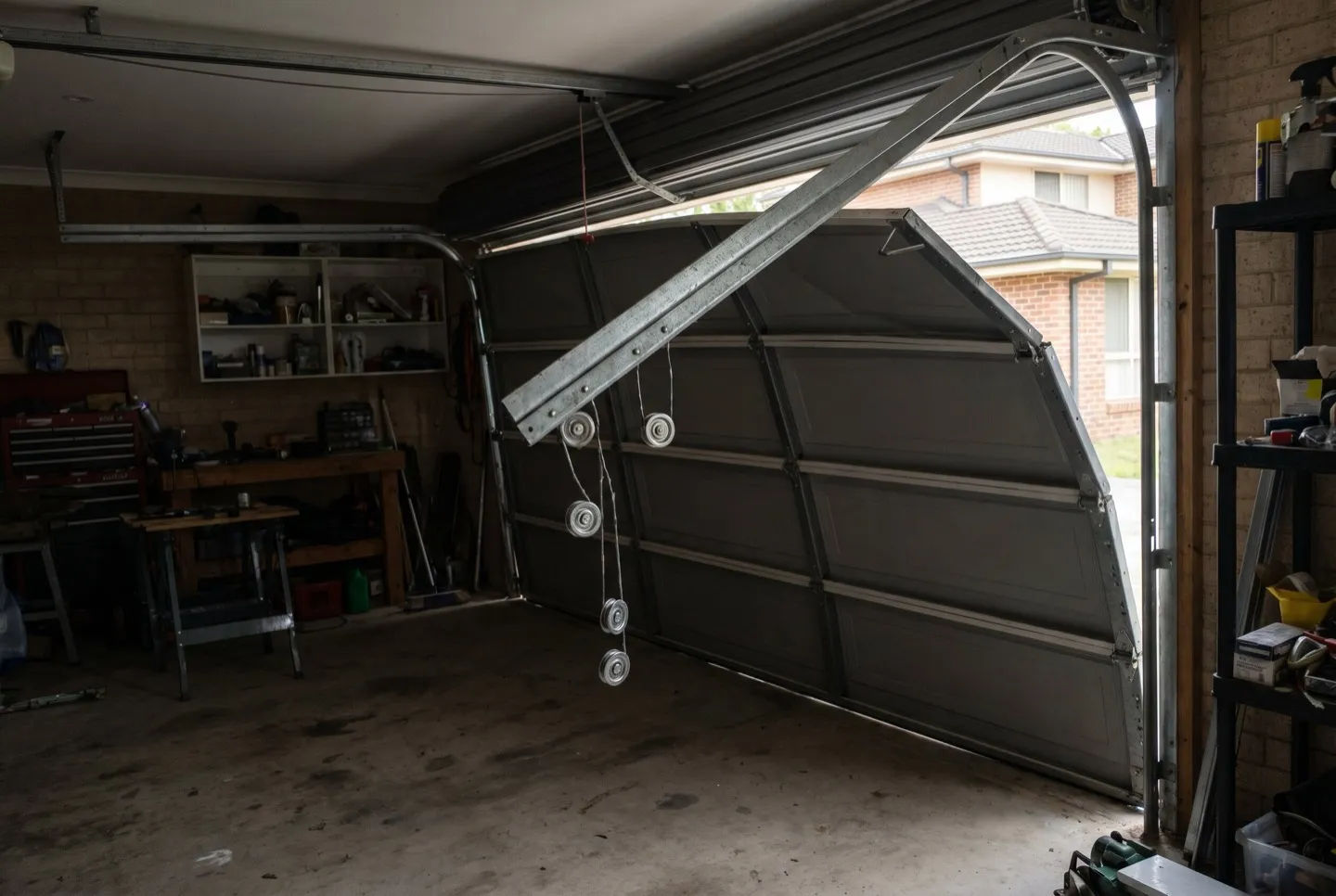
Springs and lifting cables hold a great deal of tension. Adjusting, loosening or replacing them without training can cause serious injury.
If the door is hard to lift by hand, sits unevenly, drops when released or you can see a frayed cable or a gap in a spring coil, leave it and call a professional. The same goes for bent tracks you can't straighten by tightening a bracket. If you're not sure what a symptom means, our Tension Check points to the likely cause and the safe next step.
Your spring garage door check, on one page
Print this, stick it inside the garage and tick it off.
In check order. The boxes tick on screen, and the list prints as it stands.
If something didn't look right
Most doors will pass most of these checks. The point is knowing, before a storm, which parts of yours don't.
If the manual release didn't behave, a safety test failed, you found daylight under the seal or a spring or cable looks wrong, get in touch with Foundry Garage Doors through the enquiry form. Tell us what you found and which check turned it up, and we can talk through the next step with you.
Sources
- NSW SES, "El Niño sharpens focus on storm preparedness across NSW", media release, 21 August 2026: https://www.ses.nsw.gov.au/news/el-nino-sharpens-focus-storm-preparedness-across-nsw
- Bureau of Meteorology, "The Bureau issues long-range forecast for spring", 27 August 2026: https://www.bom.gov.au/news-and-media/the-bureau-issues-long-range-forecast-for-spring
Tell us what the door's doing
Send it through and we'll sort the right fix.
Repair, opener, service or a new door, describe it in your own words and we'll come back to line up a call-out or a free measure & quote. No number to ring around; the form comes straight to us.
Not sure which? Run the Tension Check and it'll point you the right way.