
Guide
Your garage door in storm season: why the biggest opening matters to your roof
Fallen trees and damaged roofs made up more than half of the NSW SES's storm-season work last season, and the garage door belongs in that story because, as the widest opening in most homes, its failure in strong wind can pressurise the house from inside and add to the load on the roof.
Last storm season the NSW SES responded to more than 23,000 incidents, and two kinds of job dominated: about 7,000 for fallen trees and more than 6,500 for leaking and damaged roofs.
Put those two together and trees and roofs come to roughly 13,500 call-outs. That is more than half the season's work. This is our estimate: 7,000 plus 6,500 is 13,500, and 13,500 against the 23,416 incidents on the SES storm page is about 58%.
Here is why that matters at your garage. Engineering research shows that when an opening forms in a wall, wind pressurises the inside of the building and raises the net uplift load on the roof. In most homes the widest opening in any wall is the garage door. The NSW storm season runs September to April, so it is under way now.
How busy was the SES last storm season?
Source: NSW SES.
Very. Of those 23,000-plus incidents, 18,905 were storm-related emergencies. These are figures for the whole of NSW, not for Newcastle.
The counts don't name garage doors. The door's part in the story is the way a roof gets into trouble, which the next section shows.
Is my garage door a weak point in a storm?
Source: Frontiers; National Emergency Management Agency.
It can be. The National Emergency Management Agency says garage and other large access doors are at risk in strong winds. They can be dislodged from tracks or other retaining hardware, and a failure can cause serious damage and major structural damage to the property.
The mechanism is simple. A paper from James Cook University's Cyclone Testing Station lists doors or windows that broke under differential wind pressure as one way a wall opening forms. Once it is open, air rushes in and pushes up on the roof from below while the wind outside lifts it from above. The same paper says that can cause severe structural failure.
One case shows it clearly. After Tropical Cyclone Seroja in Western Australia, investigators found roof tie-down capacity was exceeded immediately after windward-wall damage raised internal pressure. That was a cyclone, not a NSW storm. We use it only because it shows the order things fail in.
Storm prep is often treated as a roof-and-trees job, but the garage door belongs on the list too, because garage and other large access doors are at risk in strong winds. At Foundry Garage Doors we think of the door as part of the roof story, not a separate chore.
Does a Newcastle thunderstorm carry the same risk as a cyclone?
"Even in years where drier conditions may be expected, we can see severe storms with damaging and destructive winds, large hail, intense rainfall and localised flooding."
NSW SES Commissioner
Not the same, and it helps to be straight about the difference. Thunderstorm strong winds typically last minutes, whereas cyclones can last hours. The NEMA page quoted above is written for cyclone regions, so read it as the wind-pressure principle rather than a rule for Newcastle homes.
The principle still holds in a short, sharp storm. A door that gives way lets the wind in, whatever the storm is called.
For Newcastle and the Hunter, which sit east of the Great Dividing Range, the Bureau of Meteorology says the spring signal is more variable, with warm Tasman Sea temperatures. It adds that coastal troughs and thunderstorms can interrupt the dry period, with heavy rain, damaging winds, large hail and flash flooding. The SES also notes that El Niño can mean greater weather variability.
Short storms still do real damage. When a tornado hit Ulladulla's CBD on 3 October 2026, the SES described roofs blown off properties, windows shattered and homes and businesses affected.
Warning time can be short too. The SES says storms can happen quickly and without much warning, and that you may not always receive an official warning. Heavy cloud, darkening skies, rising wind and thunder are your cue.
What does "wind-rated" mean on a garage door?
| What the source says | Where it applies |
|---|---|
| Under AS/NZS 1170.2, normally closed doors, including large access doors, are treated as openings unless designed to resist ultimate-limit-state wind pressuresSource: Frontiers | Building wind-load design (JCU paper) |
| Doors that don't comply with the current standard should be reinforced with a bracing system, guidance in AS/NZS 4505; rated low cost, suitable for a handypersonSource: National Emergency Management Agency | Written for cyclone regions (NEMA); read as wind-pressure principle in NSW. |
| Debris resistance is not requiredSource: Frontiers | Non-cyclonic regions (JCU paper) |
In plain terms, a wind-rated door is one designed and tested to hold against wind for its site. That covers wind pushing in on the face that takes the gust and suction pulling out on the other side. Under the wind-loading standard, AS/NZS 1170.2, doors, including large access doors, that are normally closed must be treated as openings unless designed to resist the ultimate-limit-state wind pressures. In other words, a door not designed for those pressures is counted as a hole in the wall that might open.
NEMA says doors that don't comply with the current standard should be reinforced with a bracing system, with guidance in AS/NZS 4505. It rates that as low cost and suitable for a handyperson. Remember that this guidance is written for cyclone regions. The same JCU paper notes that debris resistance is not required in non-cyclonic regions.
So what does that mean for an older door in a NSW suburb? It means it is worth knowing what you have. A trade inspection can tell you whether bracing or an upgrade is worth considering for your door and your site. Neither is a guarantee against damage.
What should I check on the garage door before the next storm?
Around the door (SES advice)
- Source: NSW SES
- Source: NSW SES
- Source: NSW SES; NEMA
- Source: NSW SES
- Source: NSW SES
- Source: NSW SES
- Source: NSW SES
On the door (general trade guidance)
The boxes tick on screen, and the list prints as it stands.
A ten-minute walk-round covers most of it. Our spring storm-season check for your garage door goes through the door itself in detail. Here is the short version, with the SES advice that sits around it.
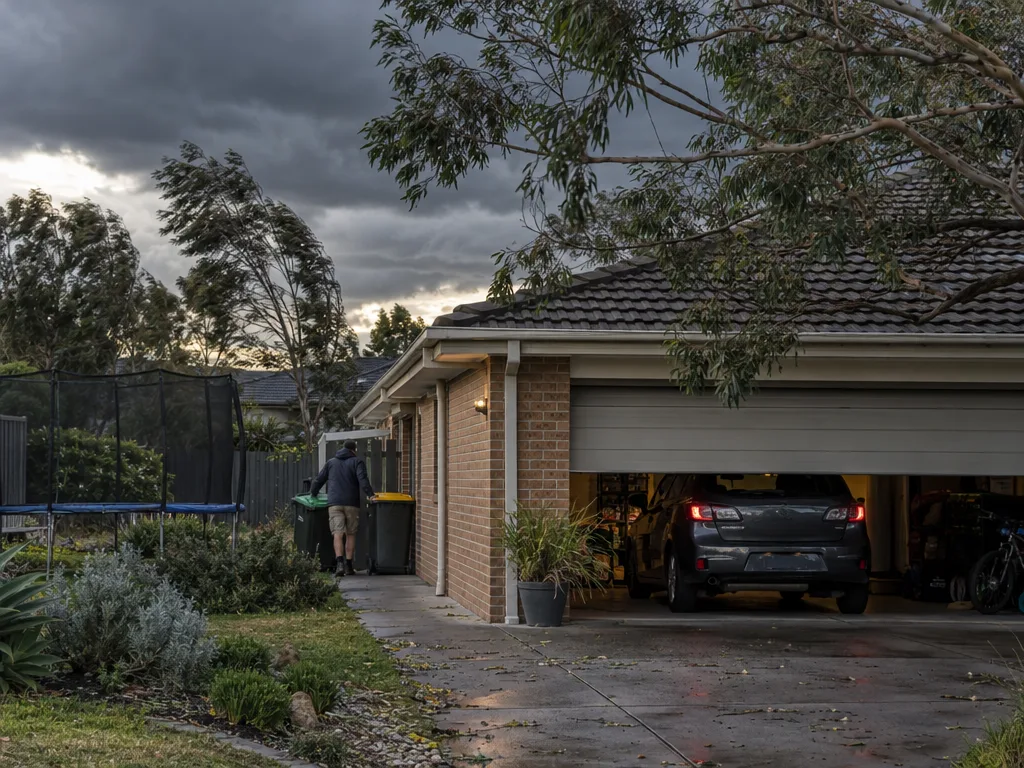
- Get the car inside. The SES says to park cars under secure cover (garages, carports), away from trees, powerlines and low-lying areas.
- Tie down loose items. In an SES simulation, unsecured trampolines and outdoor furniture became "lethal projectiles". Wheel the bins in while you're at it.
- Look at the tracks, brackets and fixings. Anything loose, rusty or sitting crooked is worth a closer look. Near the coast, our guide on why garage doors near the salt wear out sooner is useful reading.
- Try the manual release. Make sure you can open and close the door by hand if the power goes.
- Notice how it runs. If the door shudders, gaps or drifts, our Tension Check page helps you describe what it's doing.
- Trim what overhangs. The SES says to trim trees and overhanging branches. NEMA's cyclone guidance puts the line at trees that overhang the roof or are within 6 m of the house.
- Do the SES basics. Fix roof damage including broken or missing tiles and leaks, clean gutters, downpipes and drains, and make sure insurance is current.
- Set up warnings. The SES suggests you download the Hazards Near Me app and set watch zones.
Plan as if help may be slow. The SES says plainly that NSW SES may not be able to rescue you during storms.
What if my garage door is damaged after a storm?
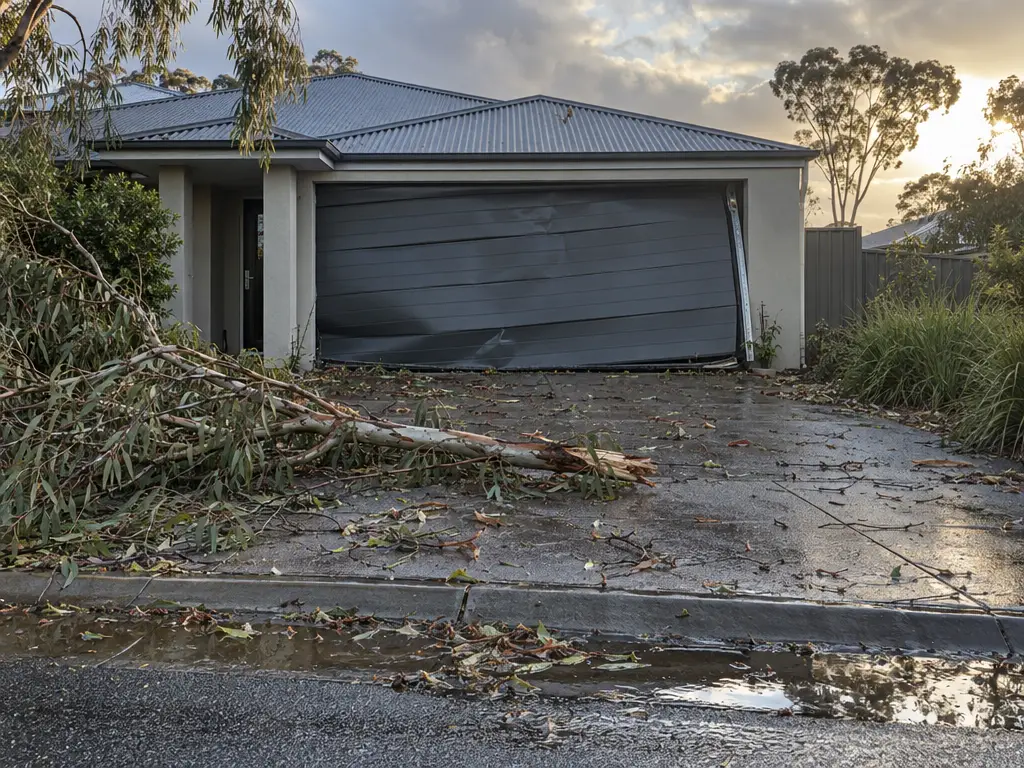
Leave a bent or dislodged door alone. Forcing it, by hand or with the opener, can drop it or release a spring under tension. Keep well clear of any fallen powerlines.
If a life is threatened, call Triple Zero (000). For flood and storm help, the NSW SES number is 132 500.
Once it is safe, the SES says to arrange safety inspections and repairs, including gas and electricity connections, to contact professionals to assess damage and to contact your insurer. If you rent, contact your landlord for urgent repairs. Have the door and the opener checked before you use either again.
What are the season's key numbers?
- more than 23,000incidentsSource: NSW SES
- 18,905storm-related emergenciesSource: NSW SES
- about 7,000fallen treesSource: NSW SES
- more than 6,500leaking or damaged roofsSource: NSW SES
- Trim trees within 6 m of the house (NEMA)Source: National Emergency Management Agency
- NSW SES 132 500 for flood and storm help; Triple Zero (000) when life is threatenedSource: NSW SES
Source: NSW SES; National Emergency Management Agency.
Four figures tell the story of last season: more than 23,000 incidents, 18,905 storm emergencies, about 7,000 fallen trees and more than 6,500 damaged roofs. Trees and roofs lead the list. The garage door is the opening that can turn a strong gust into a roof problem.
What should I do next?
Do the walk-round before the next run of hot, humid afternoons builds into a storm. Car in, loose items secured, branches trimmed, and a hard look at the door's tracks and fixings.
If something is loose, the door sits out of line or you want to know whether bracing is worth considering, book a repair or ask for a quote on Foundry Garage Doors' enquiry page. Tell us what you noticed on your walk-round and we'll take it from there.
Sources
- https://www.ses.nsw.gov.au/news/el-nino-sharpens-focus-storm-preparedness-across-nsw
- https://www.ses.nsw.gov.au/stormseason
- https://www.ses.nsw.gov.au/resources/english-storm-collateral
- https://www.nema.gov.au/our-work/resilience/national-resilience-action-library/develop-cyclone-preparedness-plan
- https://www.frontiersin.org/journals/built-environment/articles/10.3389/fbuil.2022.970673/full
- https://newshub.medianet.com.au/2026/10/media-release-nsw-ses-shoalhaven-units-boost-community-preparedness-after-tornado-strikes-ulladulla-2/175213/
- Pictures in this guide are illustrations, not photos of our jobs.
Tell us what the door's doing
Send it through and we'll sort the right fix.
Repair, opener, service or a new door, describe it in your own words and we'll come back to line up a call-out or a free measure & quote. No number to ring around; the form comes straight to us.
Not sure which? Run the Tension Check and it'll point you the right way.