
Guide
Embers and your garage door: the 2 mm gaps to check this bushfire season
Most homes lost to bushfire are lost at least partly to embers, and three national sources set the same limit of 2 mm for gaps in external openings, so the bottom edge, sides and header of your garage door are worth checking while the danger period runs.
Three separate national sources draw the line for an ember-sized gap in exactly the same place. YourHome lists gaps of no more than 2mm for all external openings as a key way to cut bushfire risk. NEMA says to make sure there are no gaps greater than 2mm in garages and carports. CSIRO recommends sealing all gaps larger than 2mm around doors.
That matters because embers do most of the damage. YourHome attributes around 80% of houses lost to ember attack, either alone or combined with other bushfire attack mechanisms.
Now look at your garage door. It is usually the widest external door on the house. It has a bottom edge sitting on the slab, two side jambs and a header across the top. At Foundry Garage Doors we think of it as one large external door with a great deal of edge to check against that 2 mm line.
The NSW Bush Fire Danger Period is running now through March. Here is how to check the door, the shed and the ground in front of both.
Why are embers, not flames, the garage door's problem?
Houses lost attributed to ember attack, alone or combined with other bushfire attack mechanisms: around 80%
Source: YourHome.
Ember attack is the most common cause of building damage or destruction from bushfires. A wall of flame does not have to reach your street for a house to be at risk.
Embers can gain entry through gaps in a building's façade and can be pushed under doors. The bottom of a garage door is exactly that kind of place.
They can also ignite outdoor elements such as welcome mats and outdoor furniture. What sits in front of the door matters as much as the door itself.
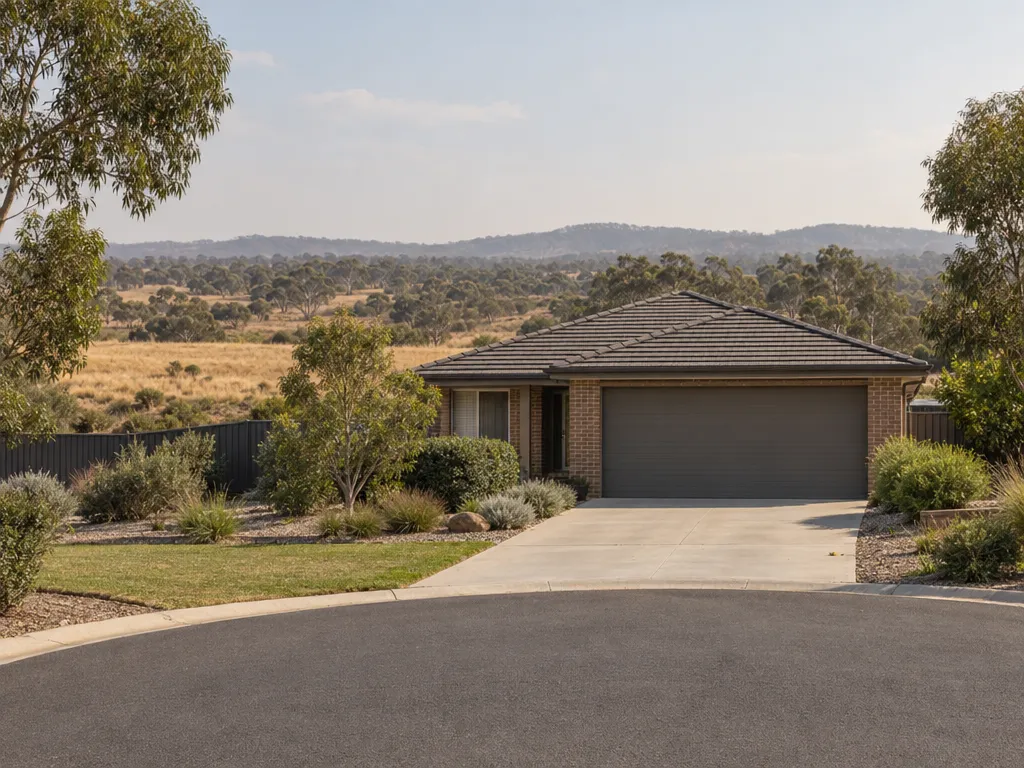
Living away from deep forest is no exemption: the RFS says if you live even close to bushland, you're at risk, and it counts scrub, grassland, crops, woodland and farmland as bushland.
Where can embers get into a garage door?
- Bottom edge on the slab: embers can be pushed under doors
- Side jambs: gaps in seals and surfaces
- Header across the top
- Door mat: outdoor items can ignite
Gaps in external openings: no more than 2 mm
Gap-closing options NEMA suggests
- brush seals
- steel ember mesh
- fire-rated silicone
Source: YourHome; National Emergency Management Agency; CSIRO.
CSIRO says embers get into doors through breaks or gaps in their seals and surfaces. On a garage door, that points to three places:
- The bottom edge. Concrete slabs are rarely dead flat, and a worn or split bottom seal leaves a line of daylight.
- The sides. Jamb seals can open up as a door ages or drops out of balance. The tracks themselves are different: AS 3959:2018 notes that on vehicle access doors, guide tracks do not permit direct access for embers and do not require edge gap protection.
- The header. The strip across the top is easy to forget because it sits above eye level.
A simple first look needs no tools. Close the door on a bright day, turn the garage light off and look along all four edges from inside. Daylight usually means a gap worth measuring.
For scale, here is our estimate. A common double door of about 4.8 m by 2.1 m has roughly 13.8 m of edge: 4.8 m along the bottom, 4.8 m across the header and 2.1 m up each side. A gap over 2 mm along the bottom edge or the header is a gap the guidance says to close.
To close gaps around the garage, NEMA suggests brush seals, steel ember mesh, and fire-rated silicone. For the door itself, it suggests steel panel garage doors that have fire-rated seals. The RFS puts the same idea more broadly: fit seals around doors and windows to eliminate gaps.
If your garage has a pedestrian side door, CSIRO suggests protecting it with a self-closing screened door with mesh apertures under 2 mm. It also says to avoid plastic shutters and flyscreens, because they melt.
Set your expectations about the work involved. NEMA's table rates its whole garage and carport action, which covers building them in non-combustible materials, as Medium cost with a builder required. That rating covers more than a seal swap, but it shows this is not a quick weekend job.
New seals also change how a door sits and runs, so a seal check is a sensible job for a door tradesperson. No seal makes a door fireproof. The aim is fewer gaps, not a promise.
Check if you're in bush fire prone land
| Where to check | What to know |
|---|---|
| RFS online tool | Maps are prepared by council and certified by the RFS Commissioner. Councils can amend the map at any time. |
| Your council | |
| Section 10.7 Planning Certificate | |
| On bush fire prone land, requirements for new building and alterations depend on the property's Bush Fire Attack Level (BAL). | |
Source: NSW RFS, bush fire prone land; NSW RFS, what you need to know.
Bush fire prone land maps are prepared by council and certified by the RFS Commissioner. You can check your property in three ways: the RFS online tool, your council, or a Section 10.7 Planning Certificate.
Councils can make amendments to the bush fire prone land map at any time. A certificate from the year you bought may not match today's map.
The answer matters most when you plan to replace or alter a door. On bush fire prone land, requirements for new building and alterations depend on the property's Bush Fire Attack Level, or BAL. The RFS says external doors need materials and proper seals suited to the level of risk.
If you are on mapped land and a new door is on the cards, find out your BAL first. Your certifier or council can tell you what applies to your property. A door supplier cannot decide that for you.
For a wider look at the whole house, the RFS offers a Bush Fire Household Assessment Tool.
What should you clear from around the garage door and the shed?
- Source: NSW RFS
- Source: National Emergency Management Agency
- Source: National Emergency Management Agency
- Source: National Emergency Management Agency
- Source: NSW Government
- Source: NSW RFS
The boxes tick on screen, and the list prints as it stands.
Garages and sheds collect exactly what the guidance says to move. The RFS says to remove door mats, wood piles, mulch, leaves, paint, and outdoor furniture that can burn from around your home.
The concrete in front of the door should be bare. The welcome mat goes inside or away.
Inside, NEMA says to store combustibles safely and to consider a safety cabinet for storing flammable materials and chemicals. Spare fuel, thinners and half-used paint tins near the door are worth relocating.
If you have a carport, NEMA also says to clear plants and debris from around vertical posts. Leaves pile up against posts.
Gas cylinders get their own rule. NEMA says to point the vent away from structures, exit paths, windows, vents and doors and to secure cylinders with a chain or cable to a solid structure. The NSW Government says to store gas bottles as far away from the house as possible with the outlet pointing away from the house.
While you are out there, the RFS suggests having hoses long enough to reach around the house.
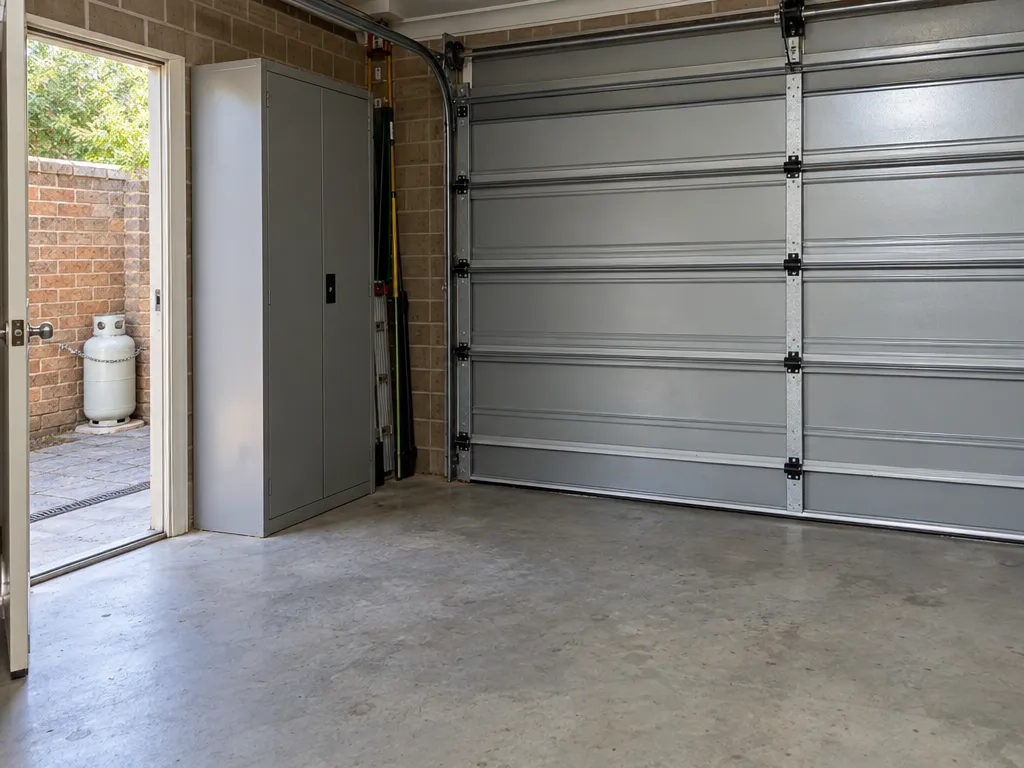
Can you get the door open if the power goes out?
This is a practical check rather than a rule. It is worth doing on a calm day, not on a bad one.
Most automatic doors have a manual release, usually a cord or handle hanging from the opener rail. Find yours and learn what it does.
With the door fully closed and everyone clear, try lifting the door by hand after releasing it. If it lifts smoothly, you know how to get the car out without power.
If the door feels very heavy, won't stay up or drops, stop. That usually points to spring tension, which is a job for a door tradesperson. Our Tension Check page describes the signs.
If the release cannot be reached from the floor, leave it for a tradesperson rather than climbing a ladder.
Planning to leave early does not make preparing the house pointless: the RFS says the more you prepare your home, the more likely it will be to survive a bush fire or ember attack.
The RFS also warns that some fires start and spread so quickly there may not be any time for a warning. Knowing how your door works is part of being ready to go. When a fire threatens, CSIRO advises closing all windows and doors.
Why does this season deserve attention now?
- 14 Aug 2026 NSW Government says El Nino conditions established, high potential for a challenging summer.
- 19 Aug 2026 AFAC spring outlook, heightened risk across northern and southeastern NSW.
- 1 October to 31 March NSW Bush Fire Danger Period (may vary due to local conditions).
Bushfires can still occur in regions with a normal outlook.
Source: NSW RFS; NSW Government; AFAC.
The RFS says the statutory Bush Fire Danger Period runs from 1 October to 31 March, however it may vary due to local conditions. Newcastle and Lake Macquarie are both listed as Fire Permit required: Yes.
That matters if your clean-up includes burning garden waste. A permit is needed at all times if a fire is likely to be dangerous to a building. A Total Fire Ban automatically suspends a permit, and penalties under the Rural Fires Act 1997 include up to 12 months' prison.
The outlook adds weight. AFAC's spring 2026 outlook predicts a heightened risk of fire across northern and southeastern New South Wales, driven by dry conditions in the east. AFAC also notes that bushfires can still occur in regions with a normal seasonal outlook.
The NSW Government said in August that with El Nino conditions established, there is a high potential for a challenging summer. The release cites forecasts showing an increased likelihood of above-average temperatures and below-average rainfall, and says many parts of NSW were left unusually dry after autumn.
Agencies have been busy. The same release reports more than 124,000 hectares of public and private land treated by hazard reduction since 1 July 2025, protecting more than 174,000 properties. The gaps around your own door are still yours to close.
Storm season overlaps all of this. The garage door is the biggest opening in a storm too, as our guide on storm season and wind pressure on your roof explains. Our spring storm-season check covers the storm side of the same door.
Renting, or need a hand to prepare?
If you rent, the NSW Government says tenants should discuss maintenance concerns with the property manager or owner. A split bottom seal or a gap down the side of the door is a fair thing to raise now rather than in January.
Whether you rent or own, the RFS suggests checking that home and contents insurance is up to date.
If you are older or live with a disability, cannot prepare your property yourself and are on bush fire prone land, AIDER is a free program that can help.
The season's checked figures in one place
- Gaps in external openings: no more than 2 mmSource: YourHome; NEMA and CSIRO give the same figure
- Ember screen mesh apertures: under 2 mmSource: CSIRO
- Houses lost attributed to ember attack, alone or combined with other mechanisms: around 80%Source: YourHome
- Bush Fire Danger Period: 1 October to 31 March, may vary with local conditionsSource: NSW RFS
- Hazard reduction since 1 July 2025: more than 124,000 hectares of public and private landSource: NSW Government
These are the numbers worth keeping in your head through to March. Gaps in external openings should be no more than 2 mm. Ember screen mesh should have apertures under 2 mm. Around 80% of houses lost are attributed to ember attack. The danger period runs until 31 March unless local conditions vary it. Each figure links to its source above.
Your next step: get the gaps looked at before summer
Start with the free checks: the daylight test along the edges, a clear slab in front of the door and the gas bottle moved and chained.
If you can see light along the bottom, sides or header, a door tradesperson can look at the seals and how the door sits. If you are on bush fire prone land and weighing up a new door, find out your BAL before you choose.
If you'd like Foundry Garage Doors to look over your door's seals and gaps, tell us what you're seeing on our quote and repair booking page, and we'll take it from there.
Sources
- https://www.yourhome.gov.au/live-adapt/bushfire-protection
- https://www.nema.gov.au/our-work/resilience/national-resilience-action-library/keep-your-house-renovations-bushfire-safe
- https://research.csiro.au/bushfire/new-builds/windows-and-doors/
- https://www.rfs.nsw.gov.au/plan-and-prepare
- https://www.rfs.nsw.gov.au/plan-and-prepare/prepare-your-property
- https://www.rfs.nsw.gov.au/plan-and-prepare/building-on-bush-fire-prone-land/bush-fire-prone-land
- https://www.rfs.nsw.gov.au/plan-and-prepare/building-on-bush-fire-prone-land/what-you-need-to-know
- https://www.rfs.nsw.gov.au/fire-information/BFDP
- https://www.afac.com.au/public-resources/seasonal-bushfire-outlook-spring-2026
- https://www.nsw.gov.au/ministerial-releases/preparations-for-bush-fire-season-advance
- https://www.nsw.gov.au/emergency/bushfire/prepare/prepare-your-home
Tell us what the door's doing
Send it through and we'll sort the right fix.
Repair, opener, service or a new door, describe it in your own words and we'll come back to line up a call-out or a free measure & quote. No number to ring around; the form comes straight to us.
Not sure which? Run the Tension Check and it'll point you the right way.